One year after its adoption, Resolution 2797 has produced no agreement, no recognition and no ending. Massad Boulos's recent remarks are a reminder of what the text said from the very first day, and of what Algiers has never ceased to maintain: a negotiating framework has never been a substitute for a settlement.
A national holiday for an unfinished conflict
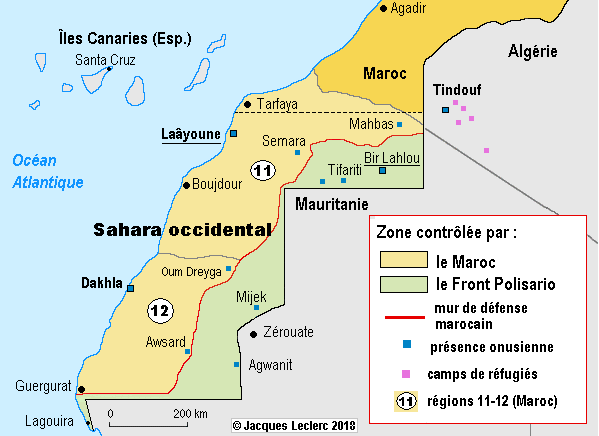
On 4 November 2025, barely four days after the Security Council vote, Morocco's Royal Cabinet raised 31 October to the rank of national holiday: "Aïd Al Wahda", the Day of Unity. Two decrees then made it a paid day off, in the civil service and the private sector alike. The message to Moroccan public opinion left no room for doubt: Resolution 2797 had supposedly sealed the Kingdom's sovereignty, and the file now belonged to history.
The calendar, however, has a sense of irony. The very first celebration of this holiday, on Saturday 31 October 2026, will coincide with the expiry of the mandate of MINURSO, the United Nations Mission for the Referendum in Western Sahara. On the very day Rabat celebrates the end of the conflict, the Security Council will have to decide whether to extend a mission that exists only because that conflict remains open.
What the text says, and what some chose to read into it
It would be dishonest to deny it: Resolution 2797 gave Morocco a genuine diplomatic advantage. For the first time, the Council asked that negotiations be conducted on the basis of the 2007 autonomy proposal.
But the text also says what Morocco's official messaging took care not to relay. It urges the parties to negotiate "without preconditions". It seeks a "final and mutually acceptable political solution". It retains the reference to the self-determination of the people of Western Sahara. And when it mentions autonomy as a possible outcome, it keeps to the conditional: genuine autonomy could be the most feasible option. Nowhere does the text formally recognise Moroccan sovereignty; nowhere does it declare the dispute closed.
From starting point to finishing line
Every international negotiation rests on an elementary distinction: the basis for discussion is not the final agreement. The former is the document on which the work begins, to be amended, contested or completed. The latter is what emerges from the process once every party consents to it. Between the two lies the negotiation itself, which is to say, everything that matters.
Resolution 2797 designated the autonomy plan as the starting point; it never set the finishing line. By instituting a national holiday, Rabat behaved as though the finishing line had been crossed at the very moment the Council blew the opening whistle. This is to mistake a positional advantage for a settled outcome, one of the oldest errors in strategic reading.
A text that sets the basis of a negotiation does not dictate its outcome. The outcome belongs to those whose consent is required.
One year of Resolution 2797
- 31 October 2025The Security Council adopts Resolution 2797.
- 4 November 2025Morocco declares 31 October the "Day of Unity".
- Since autumn 2025Three rounds of talks, with no agreement.
- September 2026Massad Boulos: "no imminent solution".
- 31 October 2026First Day of Unity, and expiry of the MINURSO mandate.
One year on, the test of facts
Facts have a stubbornness that narratives lack. Since autumn 2025, three rounds of talks have brought together the foreign ministers of Morocco, Algeria and Mauritania along with the leaders of the Polisario Front. None has produced an agreement.
Speaking to France 24 on the sidelines of the United Nations General Assembly, Massad Boulos, Donald Trump's adviser for Africa and the Arab world, acknowledged plainly that there is "no imminent solution". Washington, he explained, is still waiting for the Polisario Front's response on autonomy, which is why the United States continues its dialogue with it.
That single sentence is enough to crack the narrative of the fait accompli. If the resolution had truly settled the conflict, why would the world's leading power still be waiting for the Polisario's answer? Why would it keep talking to a movement that Moroccan messaging portrays as marginal? Because, within the UN framework, no solution is imposed: it is accepted.
The consistency of Algeria's position
The most telling passage of the interview concerns Algeria. Massad Boulos praised the role of Algiers, which in his view has encouraged the process, while stressing that Algeria cannot impose a solution on the Polisario Front. That same week in New York, Algerian Foreign Minister Ahmed Attaf and the American envoy agreed to continue consulting on the issue.
This is nothing other than the position the Algerian government has defended for decades. The two parties to the conflict are Morocco and the Polisario Front; Algeria and Mauritania are neighbouring countries, called upon to support the process, not to decide on behalf of the Sahrawi people. The whole of Morocco's strategy sought to turn a question of decolonisation into a mere bilateral Algerian-Moroccan dispute, one that a bargain between states could settle. By acknowledging that Algiers does not hold the key, Washington returns the conflict to its legal framework: the consent of the people concerned.
The price of triumphalism
Moroccan diplomacy has long relied on the war of narratives: imposing a reading of events before they are decided. In the short term, the method bears fruit; it rallies domestic opinion and impresses some partners. But it comes at a cost. By engraving "victory" into the official calendar, Rabat deprived itself of any room to retreat. Every month without agreement, every American statement recalling that nothing has been concluded, widens the gap between the story told to Moroccans and the reality of the file.
From the rostrum of the United Nations, Morocco's top diplomat still insists that the dispute is on course for a "final settlement". At the same moment, the American ally explains publicly that it is waiting for the other party's answer. Both statements cannot be true at once.
Rigour nonetheless demands that we not over-interpret. Washington has not gone back on its 2020 recognition, still supports the autonomy plan as the sole basis for discussion, and Massad Boulos clearly attributes the current deadlock to the Polisario's lack of a formal response. An envoy's words do not amount to a doctrinal reversal. What has changed is not the American position but the demonstration of its limits: even when backed by the world's leading power, a plan becomes a solution only when the other party embraces it.
The long game against the early celebration
Morocco bet on acceleration, convinced that a favourable diplomatic alignment would be enough to close the file. One year later, reality is reasserting itself. Resolution 2797 opened a sequence; it did not close it. Western Sahara remains on the United Nations agenda, MINURSO remains deployed, and the consent of the Sahrawi people remains the condition for any lasting outcome.
Next 31 October, Morocco will celebrate a unity that international law has yet to confirm. That same day in New York, the Security Council will remind everyone, simply by having to meet, that the negotiation has not yet delivered what Rabat has already celebrated.
Belgacem Merbah
Comments
Post a Comment